
Verify a therapist's credentials by checking their state licensing board, confirming their specific license type, and reviewing their educational background. For online therapy in New York and Connecticut, ensure the provider is licensed in the state where you are physically located during the session. RBM Marriage & Family Therapy provides licensed professionals who meet these regulatory standards for secure virtual care.
Check State Licensing Boards for Active Status
The most reliable way to verify a therapist is to search the official state licensing board database. In New York, the Office of the Professions maintains a public directory of licensed mental health professionals. In Connecticut, the Department of Public Health oversees licensure for marriage and family therapists. These databases confirm whether a license is active, expired, or suspended. They also list any disciplinary actions or complaints filed against the provider. A license number is a unique identifier that allows you to trace a professional's history within a specific jurisdiction.
When searching, use the therapist's full legal name and their specific license type. For example, a Licensed Marriage and Family Therapist (LMFT) in New York holds a different credential than a Licensed Mental Health Counselor (LMHC). Confusing these titles can lead to booking a provider who is not qualified for your specific needs. The state board entry will show the exact title and the expiration date of the license. If the license is expired, the therapist cannot legally provide clinical services in that state.
Understand the Difference Between License Types
Therapist credentials vary significantly based on education, training, and scope of practice. A Licensed Marriage and Family Therapist (LMFT) is a clinician who has completed a master's degree in marriage and family therapy and supervised clinical hours. This credential focuses specifically on systemic and relational dynamics. In contrast, a Licensed Professional Counselor (LPC) or Licensed Mental Health Counselor (LMHC) may have a broader focus on individual mental health issues. Understanding these distinctions helps you match the provider's expertise to your goals.
Associate licenses, such as LMFTA in Connecticut or LMSW in New York, indicate that the therapist is working under supervision. These professionals are still in the process of completing their post-graduate clinical hours. While they provide valuable services, they operate under the oversight of a fully licensed supervisor. If you require a specific level of autonomy or experience, you may prefer a fully independent license. Always ask the provider to clarify their current license status and whether they are practicing independently or under supervision.
Verify Educational Background and Training
Licensure is the baseline, but educational background provides deeper insight into a therapist's training. Most states require a master's degree from an accredited program for clinical licensure. You can verify the accreditation of a university through the Council for Accreditation and Certification of Social Work (CASW) or the American Association for Marriage and Family Therapy (AAMFT). Accreditation ensures that the curriculum meets national standards for clinical education. It also confirms that the institution is recognized by the state licensing board.
Specialized training is another important factor. Therapists often pursue additional certifications in specific modalities, such as Emotionally Focused Therapy (EFT) or the Gottman Method. These certifications require ongoing education and supervision. While not always required for licensure, they demonstrate a commitment to specialized skills. You can ask a therapist about their specific training in the areas you need help with. This ensures that their expertise aligns with your therapeutic goals.
Confirm Online Therapy Compliance and Location
Online therapy is regulated by the state where the client is physically located during the session. If you are in New York, your therapist must hold a valid New York license. If you are in Connecticut, they must hold a Connecticut license. This rule applies regardless of where the therapist is physically sitting. Telehealth laws are designed to protect consumers by ensuring that providers are accountable to the local regulatory body. RBM Marriage & Family Therapy adheres to these standards, providing secure online sessions for clients located in New York and Connecticut.
Some therapists hold licenses in multiple states, which allows them to serve clients across state lines. However, not all providers have multi-state licensure. If you travel frequently, ask the therapist about their licensing status in the states you visit. This prevents interruptions in care due to regulatory barriers. You can verify multi-state licensure by checking the licensing boards in each relevant state. This step is crucial for maintaining continuity of care in a virtual setting.
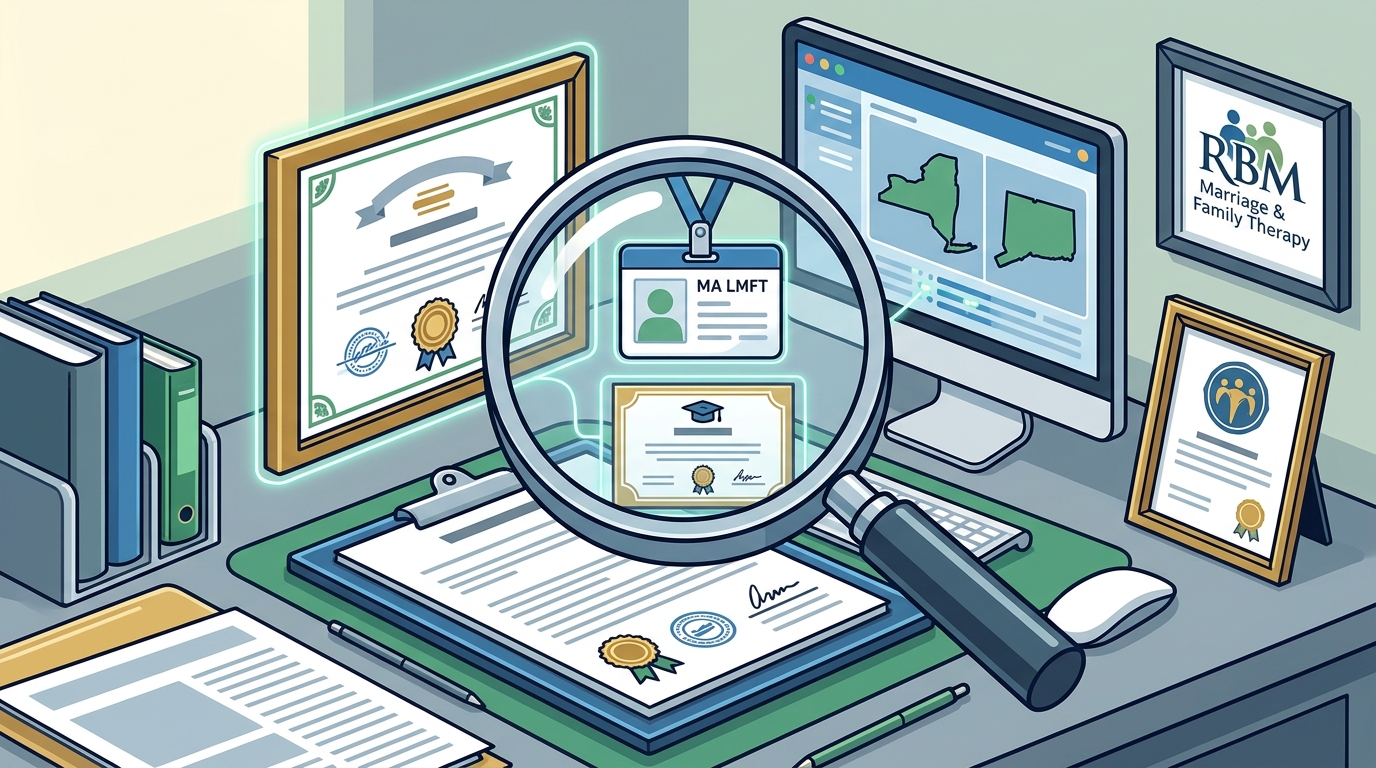
Review Professional Memberships and Ethics
Membership in professional organizations can provide additional assurance of a therapist's commitment to ethical practice. The American Association for Marriage and Family Therapy (AAMFT) is the primary professional body for marriage and family therapists. Membership requires adherence to a strict code of ethics and ongoing professional development. While membership is not a substitute for licensure, it signals that the therapist is engaged with the broader professional community. It also provides access to resources and peer support that enhance clinical quality.
Ethical complaints are another area to investigate. State licensing boards often publish records of disciplinary actions, including fines, suspensions, or license revocations. These records are public and can be searched by name. A clean record is a positive indicator, but it is not a guarantee of quality. However, a history of serious ethical violations is a significant red flag. Always review the disciplinary history before booking an initial consultation. This due diligence protects your well-being and ensures a safe therapeutic environment.
Key Takeaways
- Search the state licensing board database to confirm the therapist's license is active and in good standing.
- Identify the specific license type, such as LMFT or LMHC, to ensure it matches your therapeutic needs.
- Verify that the therapist's educational institution is accredited by a recognized national body.
- Ensure the therapist is licensed in the state where you are physically located during online sessions.
- Check for disciplinary actions or complaints in the state board's public records.
- Ask about specialized training and certifications in the specific modalities you are seeking.
Frequently Asked Questions
How do I check if a therapist is licensed in New York?
You can search the New York State Office of the Professions website. Enter the therapist's name and license type to view their active status, expiration date, and any disciplinary history.
What is the difference between an LMFT and an LMHC?
An LMFT is a Licensed Marriage and Family Therapist who specializes in relational dynamics. An LMHC is a Licensed Mental Health Counselor who may focus on individual issues. Both are licensed clinicians, but their training emphases differ.
Can a therapist in Connecticut treat a client in New York?
Only if the therapist holds a valid license in New York. Online therapy is regulated by the client's location, so the provider must be licensed in the state where the client is physically present.
Is professional membership required for licensure?
No, professional membership is not required for licensure. However, it demonstrates a commitment to ethical standards and ongoing education. It is a positive indicator but not a legal requirement.
What should I do if a license is expired?
If a license is expired, the therapist cannot legally provide clinical services. You should look for a provider with an active license. An expired license may indicate a lapse in continuing education or other regulatory issues.
How can I verify a therapist's educational background?
Ask the therapist for the name of their graduate program. You can then check if the program is accredited by a recognized body such as the AAMFT or CASW. This confirms that their education meets national standards.