

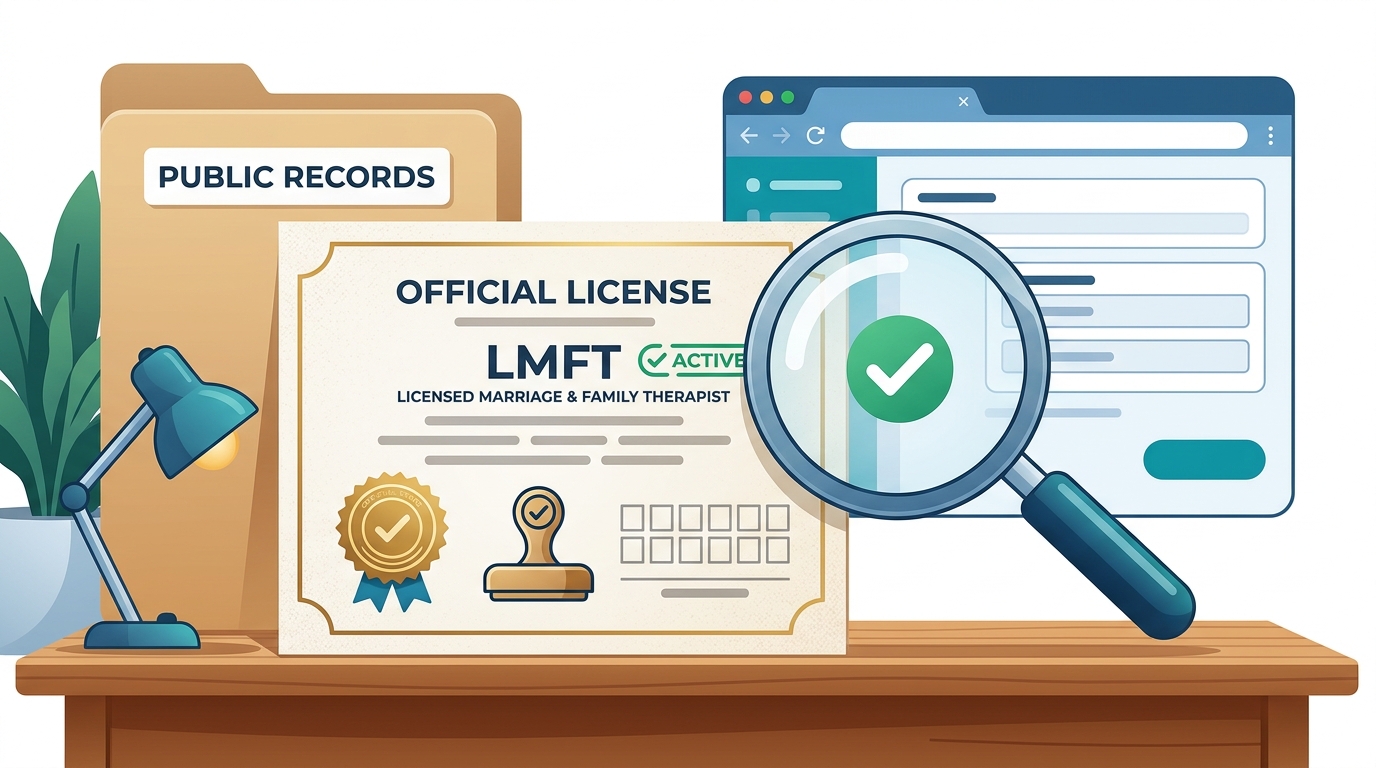
You can verify a therapist's license by searching the official state licensing board database where they are authorized to practice. This public record confirms their active status, specific credential type, and any disciplinary history. Checking this primary source is the most reliable way to ensure the provider is legitimate and legally permitted to offer clinical services in your region. according to LMFT License Lookup
Understanding Credential Types
Therapist credentials can be confusing because different letters represent different levels of education and supervision. A Licensed Marriage and Family Therapist (LMFT) is a clinician who has completed a master's degree in marriage and family therapy, passed a national exam, and completed supervised clinical hours. This specific license allows them to diagnose and treat mental health conditions independently. In contrast, an associate license, such as an LMFTA, indicates a clinician who is still completing their supervised practice hours under the guidance of a fully licensed supervisor.
It is important to distinguish between a license and a degree. A degree is an academic achievement, while a license is a legal permission granted by a state government to practice. A provider may hold a PhD or a Master's degree but not hold an active clinical license in your state. Always ask for the specific license number and the state where it is active. This distinction protects you from working with someone who is educated but not legally authorized to provide independent therapy.
State Board Verification
The most authoritative way to check a provider is through the state's Board of Behavioral Sciences or equivalent regulatory body. For example, the California Board of Behavioral Sciences provides a public license verification tool that displays primary source data from their licensing system. This database confirms the exact status of the license, including whether it is active, expired, or suspended. You can enter the provider's name or license number to retrieve this information directly from the government source.
When you search a name, verify the exact spelling and the specific credential type. If the name you search does not appear in the database, the provider is not licensed in that state. If the status shows disciplinary actions or restrictions, you should proceed with caution. This step is non-negotiable for ensuring safety. The data provided by these boards is the primary source of truth for legal practice authority.
Checking Disciplinary History
Verifying Online Availability
When seeking telehealth services, you must verify that the provider is licensed in the state where you are physically located during the session. A therapist licensed in New York cannot legally provide therapy to a client sitting in Connecticut unless they also hold a Connecticut license. This is a common misconception in online care. The location of the client, not the therapist, determines the licensing requirement for the session.
RBM Marriage & Family Therapy operates as a virtual practice serving adults and couples across New York and Connecticut. Our team members are licensed in the specific states where they provide care. This ensures that every session is conducted within legal and ethical boundaries. When you book a consultation, you are working with a clinician who is verified in your state. This compliance is essential for the validity of the therapeutic relationship and the protection of your rights as a client.
Questions to Ask
Before starting therapy, ask the provider for their full name, license type, and license number. You can then cross-reference this information with the state board database. Ask if they are currently in good standing and if they have any disciplinary actions on record. A legitimate provider will welcome these questions and provide the information without hesitation. They may even provide a link to their public profile on the state board website.
Also ask about their supervision if they hold an associate license. You need to know who is supervising their practice and how often. This ensures that you are receiving care that meets professional standards. These questions are not rude; they are standard due diligence. They help you build a foundation of trust and safety before you begin sharing personal information with a clinician.
Key Takeaways
- Always verify a therapist's license through the official state board database where they practice.
- Distinguish between academic degrees and active clinical licenses, as they serve different legal purposes.
- Check the public record for any disciplinary history or sanctions associated with the license.
- Ensure the provider is licensed in the state where you are physically located during online sessions.
- Ask for the provider's license number and verify it directly with the regulatory body.
- Transparency regarding credentials and disciplinary history is a key indicator of professional integrity.
Frequently Asked Questions
What is the difference between a license and a degree?
A degree is an academic credential earned from a university, while a license is a legal permission granted by a state government to practice. You can have a degree without a license, but you cannot legally practice independently without a license.
How do I find the correct state board to check a license?
Search for the "Board of Behavioral Sciences" or "Licensing Board" in the state where the therapist practices. Most states have a public online search tool for license verification.
Can I verify a therapist's license if they are in a different state?
Yes, you can search the board of the state where they are licensed. However, for online therapy, they must be licensed in the state where you are located during the session.
What does it mean if a license is in "good standing"?
Good standing means the license is active, all fees are paid, and there are no active disciplinary actions or restrictions on the provider's practice.
Should I be concerned if a therapist has a disciplinary record?
You should review the details of the record. Minor administrative issues may be less concerning than serious ethical breaches. You have the right to ask the provider to explain any entries.
How often should I re-verify a therapist's license?
It is a good practice to verify the license at the start of therapy and periodically if you continue with the provider for a long time. Licenses can expire or be suspended.